TEXTS
Il centro dell’Architettura
“La gran parte degli architetti ritiene che l’essenza fondamentale dell’architettura vada oltre lo scopo della fotografia. Probabilmente hanno ragione. La gran parte dei fotografi ritiene che gli edifici siano fra i soggetti più interessanti – ma che fotografare l’architettura sia un affare piuttosto monotono. Anche loro hanno ragione”.
Inizia in questo modo un articolo di John Szarkowski pubblicato nel 1959 sulla rivista Art in America. Il titolo era Photographing Architecture, e fin da subito quindi rimarcava lo stretto legame che unisce le due discipline. Ma questo incipit dice di più: nel segnalare la ripetitività del lavoro dei fotografi, infatti, evidenzia il valore eminentemente documentario che viene attribuito a questo genere di immagini, le quali, caricate di un attributo di oggettività/scientificità che certamente appartiene molto più ad altre modalità di rappresentazione degli stessi soggetti (plastici, piante, prospetti, assonometrie), costituiscono uno strumento indispensabile per lo storico e lo specialista della materia. Di qui vengono una serie di regole generiche che ne guidano la realizzazione, fra cui la scelta di annullare ogni deformazione prospettica, quella di escludere dall’inquadratura qualsiasi elemento estraneo all’edificio o alla struttura da ritrarre, e ancora la predilezione per un’illuminazione diffusa e omogenea. Con questa configurazione le fotografie di argomento architettonico hanno attraversato la storia intera di questa tecnica e di questo linguaggio fino dalla sua nascita (si pensi ai calotipi francesi di metà Ottocento di Henri Le Secq, Charles Marville e Charles Nègre, oppure ai monumenti egiziani e mediorientali ripresi da Maxime Du Camp e Francis Frith) con variazioni relativamente limitate. Così, si è detto, la fotografia è entrata a far parte degli apparati su cui si fonda il lavoro dello studioso; ma non soltanto, perché allo stesso tempo essa stessa funziona come un dispositivo per esercitare la critica e fornire un commento su ciò che contiene. Proprio Szarkowski aveva utilizzato il mezzo in questo modo pochi anni prima di scrivere le righe di cui sopra, elaborando con il banco ottico un ampio saggio visivo sul genio di Louis Sullivan.
Marco Introini è fotografo e architetto. In Italia la stessa combinazione ha una consistente tradizione: si è verificata negli anni ’30 e ’40 con Giuseppe Pagano e Alberto Lattuada costituendo uno snodo fondamentale di carriere sviluppatesi in direzioni differenti, ma ciò che più importa è il fatto che, per una serie di contingenze, gran parte degli autori emersi negli anni ’70 per il proprio lavoro di ricerca artistica si siano contemporaneamente dedicati a questo ambito con particolare assiduità e specifica competenza. Gabriele Basilico e Guido Guidi sono usciti rispettivamente dalle facoltà di architettura di Milano e Venezia, mentre fra coloro che provengono da altri interessi e aree di studio emergono le figure di Luigi Ghirri, Mimmo Jodice, Giovanni Chiaramonte, Vincenzo Castella, Olivo Barbieri. La peculiarità della situazione nazionale risiede dunque nel fatto che per un lungo periodo gli artefici dell’iconografia che appare sulle riviste di architettura e design sono gli stessi che espongono le proprie opere nei musei d’arte e costituiscono una parte fondamentale e maggioritaria dell’avanguardia fotografica tout court. Marco Introini si forma osservando il loro lavoro, e come questi fotografa senza distinguere fra professione e ricerca, mantenendo costantemente un atteggiamento problematico nei confronti del proprio soggetto.
Nella serie Shanghai. Cina Coloniale, Introini indaga un aspetto peculiare di una metropoli abbondantemente frequentata dalla fotografia contemporanea. Attraverso la giustapposizione fra soluzioni architettoniche tipicamente occidentali e il corpo della città tradizionale, risolve il tema ricorrente del rapporto fra i due emisferi culturali, ma allo stesso tempo compie un gesto atipico nella città dell’avvenire, ovvero si guarda indietro e porta alla luce una storia adombrata dai fasti del recente boom.
“La scala della fotogenia urbana è quella dell’anonimato”, scrive Jean-François Chevrier nel breve saggio pubblicato in Spectacular City - Photographing the Future, catalogo di una mostra organizzata presso il NAI di Rotterdam. Ciò è sicuramente vero, e si concretizza nel lavoro di molti fotografi che paiono ritrarre sempre lo stesso luogo in ogni parte del mondo, ma è un’osservazione che non può essere utilizzata per riferirsi a quello di Introini, in cui emergono le tipicità della Concessione Francese, del quartiere inglese e di quello americano, del Bund di Shanghai. Introini non scatta istantanee di una città generica, bensì fornisce indicazioni precise su ciò che ha di fronte. Si interessa alla singolarità. Quello che fotografa si può trovare soltanto laddove ha posato il cavalletto, e le sue immagini sono lo strumento più adatto per poterlo rintracciare.
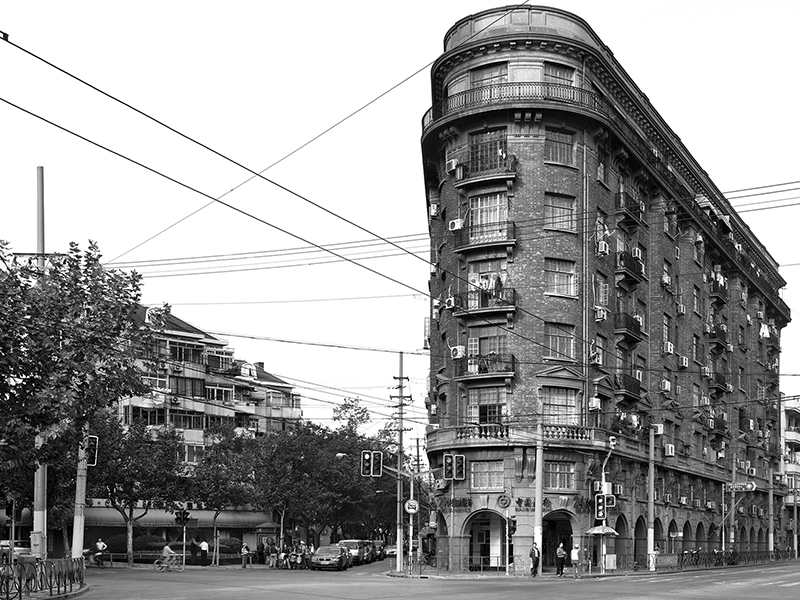
Introini concentra la sua attenzione sul centro della città, o meglio, in questo caso, su uno dei suoi centri. Sposta lo sguardo dalle periferie, dai non-luoghi, dal terzo paesaggio, oggetto di vaste ricognizioni fotografiche, a ciò che è immediatamente riconoscibile, possiede una specifica identità, non ha il carattere dell’abbandono. I fabbricati e le strade verso cui punta l’obiettivo sono popolati, spesso affollati e chiassosi. Tuttavia, questo sì, Introini limita la presenza umana all’interno delle proprie inquadrature. Come accidentalmente era accaduto a Daguerre sul Boulevard du Temple, ripulisce ossessivamente l’immagine da qualsiasi intromissione o la riduce a proporzioni minime. Ciò, nel suo caso, non implica un senso di desolazione, ma si deve parlare di precisione. L’angolo arrotondato di un palazzo sulla Huai Hai Road, nella Concessione Francese, rimanda a una ben nota immagine scattata da Gabriele Basilico nel 1980 a un soggetto analogo nel cuore di Milano. Oltre alla mancanza di persone, perfino le geometrie disegnate dai cavi aerei sono simili. L’occhio, senza distrazioni, punta diretto sulla pelle della città. Con questa Introini riempie ogni porzione del fotogramma, scandagliando il presente per leggere le tracce del passato e del futuro della forma urbana.
Francesco Zanot, in Shanghai, al Cina coloniale, Bergamo 2008
The Center of Architecture
“Most architects believe that the fundamental essence of architecture lies beyond the scope of photography. They are probably right. Most photographers believe that buildings are among the most interesting subjects – but that photographing architecture is a rather monotonous business. They too are right.”
An article by John Szarkowski published in 1959 in the magazine Art in America begins in this way. The title was Photographing Architecture, and from the outset it underlined the close bond that links the two disciplines. But this opening says more: in pointing out the repetitive nature of photographers’ work, it highlights the predominantly documentary value attributed to this kind of image which, endowed with a quality of objectivity/scientificity that certainly belongs far more to other modes of representing the same subjects (models, plans, elevations, axonometric drawings), constitutes an indispensable tool for historians and specialists in the field. From this derive a series of generic rules that guide its production, including the choice to eliminate all perspective distortion, the exclusion from the frame of any element extraneous to the building or structure being portrayed, and also a preference for diffuse, even lighting. With this configuration, photographs of architectural subjects have accompanied the entire history of this technique and this language from its very beginnings (one need only think of the mid‑nineteenth‑century French calotypes by Henri Le Secq, Charles Marville and Charles Nègre, or of the Egyptian and Middle Eastern monuments photographed by Maxime Du Camp and Francis Frith), with relatively limited variations. Thus, as has been said, photography has become part of the apparatus on which the work of the scholar is based; but not only that, because at the same time it also functions as a device for exercising criticism and providing commentary on what it contains. Szarkowski himself had used the medium in this way a few years before writing the lines quoted above, producing with a view camera an extensive visual essay on the genius of Louis Sullivan.
Marco Introini is both photographer and architect. In Italy this same combination has a solid tradition: it appeared in the 1930s and 1940s with Giuseppe Pagano and Alberto Lattuada, forming a crucial turning point in careers that then developed in different directions, but what matters most is that, due to a series of circumstances, many of the authors who emerged in the 1970s for their artistic research work devoted themselves at the same time to this field with particular assiduity and specific expertise. Gabriele Basilico and Guido Guidi came out of the schools of architecture in Milan and Venice respectively, while among those who had different interests and educational backgrounds we find Luigi Ghirri, Mimmo Jodice, Giovanni Chiaramonte, Vincenzo Castella, Olivo Barbieri. The peculiarity of the Italian situation lies therefore in the fact that for a long period the makers of the imagery appearing in architecture and design magazines were the very same people who exhibited their works in art museums and formed a fundamental and predominant part of the photographic avant‑garde tout court. Marco Introini developed by observing their work and, like them, photographs without drawing a line between professional practice and research, constantly maintaining a questioning attitude toward his subject.
In the series Shanghai. Colonial China, Introini investigates a distinctive aspect of a metropolis widely frequented by contemporary photography. Through the juxtaposition of architectural solutions that are typically Western with the body of the traditional city, he addresses the recurring theme of the relationship between the two cultural hemispheres, while at the same time performing an atypical act in the city of the future, namely he looks back and brings to light a history overshadowed by the splendours of the recent boom. “The scale of urban photogeneity is that of anonymity,” writes Jean‑François Chevrier in the short essay published in Spectacular City – Photographing the Future, the catalogue of an exhibition organized at the NAI in Rotterdam. This is certainly true, and it takes shape in the work of many photographers who seem to be portraying the same place in every part of the world, but it is an observation that cannot be applied to Introini’s work, in which the specific features of the French Concession, the English and American quarters, and the Shanghai Bund all emerge. Introini does not shoot snapshots of a generic city; rather, he provides precise indications of what stands before him. He is interested in singularity. What he photographs can be found only where he has set up his tripod, and his images are the most suitable tool for locating it.
Introini focuses his attention on the center of the city, or rather, in this case, on one of its centers. He shifts his gaze away from the outskirts, from non‑places, from the “third landscape,” the subject of extensive photographic surveys, towards what is immediately recognizable, possesses a specific identity, and does not bear the character of abandonment. The buildings and streets at which he aims his lens are inhabited, often crowded and noisy. Nevertheless, indeed, Introini limits the human presence within his frames. As had accidentally happened to Daguerre on the Boulevard du Temple, he obsessively cleans the image of any intrusion or reduces it to minimal proportions. In his case, this does not imply a sense of desolation; rather, one should speak of precision. The rounded corner of a building on Huai Hai Road, in the French Concession, recalls a well‑known image taken by Gabriele Basilico in 1980 of a similar subject in the heart of Milan. Besides the absence of people, even the geometries drawn by the overhead cables are similar. The eye, without distraction, aims straight at the skin of the city. Introini fills every portion of the frame with this skin, scanning the present in order to read the traces of the past and future of the urban form.
Francesco Zanot, in Shanghai, la Cina coloniale, Bergamo 2008
“La gran parte degli architetti ritiene che l’essenza fondamentale dell’architettura vada oltre lo scopo della fotografia. Probabilmente hanno ragione. La gran parte dei fotografi ritiene che gli edifici siano fra i soggetti più interessanti – ma che fotografare l’architettura sia un affare piuttosto monotono. Anche loro hanno ragione”.
Inizia in questo modo un articolo di John Szarkowski pubblicato nel 1959 sulla rivista Art in America. Il titolo era Photographing Architecture, e fin da subito quindi rimarcava lo stretto legame che unisce le due discipline. Ma questo incipit dice di più: nel segnalare la ripetitività del lavoro dei fotografi, infatti, evidenzia il valore eminentemente documentario che viene attribuito a questo genere di immagini, le quali, caricate di un attributo di oggettività/scientificità che certamente appartiene molto più ad altre modalità di rappresentazione degli stessi soggetti (plastici, piante, prospetti, assonometrie), costituiscono uno strumento indispensabile per lo storico e lo specialista della materia. Di qui vengono una serie di regole generiche che ne guidano la realizzazione, fra cui la scelta di annullare ogni deformazione prospettica, quella di escludere dall’inquadratura qualsiasi elemento estraneo all’edificio o alla struttura da ritrarre, e ancora la predilezione per un’illuminazione diffusa e omogenea. Con questa configurazione le fotografie di argomento architettonico hanno attraversato la storia intera di questa tecnica e di questo linguaggio fino dalla sua nascita (si pensi ai calotipi francesi di metà Ottocento di Henri Le Secq, Charles Marville e Charles Nègre, oppure ai monumenti egiziani e mediorientali ripresi da Maxime Du Camp e Francis Frith) con variazioni relativamente limitate. Così, si è detto, la fotografia è entrata a far parte degli apparati su cui si fonda il lavoro dello studioso; ma non soltanto, perché allo stesso tempo essa stessa funziona come un dispositivo per esercitare la critica e fornire un commento su ciò che contiene. Proprio Szarkowski aveva utilizzato il mezzo in questo modo pochi anni prima di scrivere le righe di cui sopra, elaborando con il banco ottico un ampio saggio visivo sul genio di Louis Sullivan.
Marco Introini è fotografo e architetto. In Italia la stessa combinazione ha una consistente tradizione: si è verificata negli anni ’30 e ’40 con Giuseppe Pagano e Alberto Lattuada costituendo uno snodo fondamentale di carriere sviluppatesi in direzioni differenti, ma ciò che più importa è il fatto che, per una serie di contingenze, gran parte degli autori emersi negli anni ’70 per il proprio lavoro di ricerca artistica si siano contemporaneamente dedicati a questo ambito con particolare assiduità e specifica competenza. Gabriele Basilico e Guido Guidi sono usciti rispettivamente dalle facoltà di architettura di Milano e Venezia, mentre fra coloro che provengono da altri interessi e aree di studio emergono le figure di Luigi Ghirri, Mimmo Jodice, Giovanni Chiaramonte, Vincenzo Castella, Olivo Barbieri. La peculiarità della situazione nazionale risiede dunque nel fatto che per un lungo periodo gli artefici dell’iconografia che appare sulle riviste di architettura e design sono gli stessi che espongono le proprie opere nei musei d’arte e costituiscono una parte fondamentale e maggioritaria dell’avanguardia fotografica tout court. Marco Introini si forma osservando il loro lavoro, e come questi fotografa senza distinguere fra professione e ricerca, mantenendo costantemente un atteggiamento problematico nei confronti del proprio soggetto.
Nella serie Shanghai. Cina Coloniale, Introini indaga un aspetto peculiare di una metropoli abbondantemente frequentata dalla fotografia contemporanea. Attraverso la giustapposizione fra soluzioni architettoniche tipicamente occidentali e il corpo della città tradizionale, risolve il tema ricorrente del rapporto fra i due emisferi culturali, ma allo stesso tempo compie un gesto atipico nella città dell’avvenire, ovvero si guarda indietro e porta alla luce una storia adombrata dai fasti del recente boom.
“La scala della fotogenia urbana è quella dell’anonimato”, scrive Jean-François Chevrier nel breve saggio pubblicato in Spectacular City - Photographing the Future, catalogo di una mostra organizzata presso il NAI di Rotterdam. Ciò è sicuramente vero, e si concretizza nel lavoro di molti fotografi che paiono ritrarre sempre lo stesso luogo in ogni parte del mondo, ma è un’osservazione che non può essere utilizzata per riferirsi a quello di Introini, in cui emergono le tipicità della Concessione Francese, del quartiere inglese e di quello americano, del Bund di Shanghai. Introini non scatta istantanee di una città generica, bensì fornisce indicazioni precise su ciò che ha di fronte. Si interessa alla singolarità. Quello che fotografa si può trovare soltanto laddove ha posato il cavalletto, e le sue immagini sono lo strumento più adatto per poterlo rintracciare.
Introini concentra la sua attenzione sul centro della città, o meglio, in questo caso, su uno dei suoi centri. Sposta lo sguardo dalle periferie, dai non-luoghi, dal terzo paesaggio, oggetto di vaste ricognizioni fotografiche, a ciò che è immediatamente riconoscibile, possiede una specifica identità, non ha il carattere dell’abbandono. I fabbricati e le strade verso cui punta l’obiettivo sono popolati, spesso affollati e chiassosi. Tuttavia, questo sì, Introini limita la presenza umana all’interno delle proprie inquadrature. Come accidentalmente era accaduto a Daguerre sul Boulevard du Temple, ripulisce ossessivamente l’immagine da qualsiasi intromissione o la riduce a proporzioni minime. Ciò, nel suo caso, non implica un senso di desolazione, ma si deve parlare di precisione. L’angolo arrotondato di un palazzo sulla Huai Hai Road, nella Concessione Francese, rimanda a una ben nota immagine scattata da Gabriele Basilico nel 1980 a un soggetto analogo nel cuore di Milano. Oltre alla mancanza di persone, perfino le geometrie disegnate dai cavi aerei sono simili. L’occhio, senza distrazioni, punta diretto sulla pelle della città. Con questa Introini riempie ogni porzione del fotogramma, scandagliando il presente per leggere le tracce del passato e del futuro della forma urbana.
Francesco Zanot, in Shanghai, al Cina coloniale, Bergamo 2008
The Center of Architecture
“Most architects believe that the fundamental essence of architecture lies beyond the scope of photography. They are probably right. Most photographers believe that buildings are among the most interesting subjects – but that photographing architecture is a rather monotonous business. They too are right.”
An article by John Szarkowski published in 1959 in the magazine Art in America begins in this way. The title was Photographing Architecture, and from the outset it underlined the close bond that links the two disciplines. But this opening says more: in pointing out the repetitive nature of photographers’ work, it highlights the predominantly documentary value attributed to this kind of image which, endowed with a quality of objectivity/scientificity that certainly belongs far more to other modes of representing the same subjects (models, plans, elevations, axonometric drawings), constitutes an indispensable tool for historians and specialists in the field. From this derive a series of generic rules that guide its production, including the choice to eliminate all perspective distortion, the exclusion from the frame of any element extraneous to the building or structure being portrayed, and also a preference for diffuse, even lighting. With this configuration, photographs of architectural subjects have accompanied the entire history of this technique and this language from its very beginnings (one need only think of the mid‑nineteenth‑century French calotypes by Henri Le Secq, Charles Marville and Charles Nègre, or of the Egyptian and Middle Eastern monuments photographed by Maxime Du Camp and Francis Frith), with relatively limited variations. Thus, as has been said, photography has become part of the apparatus on which the work of the scholar is based; but not only that, because at the same time it also functions as a device for exercising criticism and providing commentary on what it contains. Szarkowski himself had used the medium in this way a few years before writing the lines quoted above, producing with a view camera an extensive visual essay on the genius of Louis Sullivan.
Marco Introini is both photographer and architect. In Italy this same combination has a solid tradition: it appeared in the 1930s and 1940s with Giuseppe Pagano and Alberto Lattuada, forming a crucial turning point in careers that then developed in different directions, but what matters most is that, due to a series of circumstances, many of the authors who emerged in the 1970s for their artistic research work devoted themselves at the same time to this field with particular assiduity and specific expertise. Gabriele Basilico and Guido Guidi came out of the schools of architecture in Milan and Venice respectively, while among those who had different interests and educational backgrounds we find Luigi Ghirri, Mimmo Jodice, Giovanni Chiaramonte, Vincenzo Castella, Olivo Barbieri. The peculiarity of the Italian situation lies therefore in the fact that for a long period the makers of the imagery appearing in architecture and design magazines were the very same people who exhibited their works in art museums and formed a fundamental and predominant part of the photographic avant‑garde tout court. Marco Introini developed by observing their work and, like them, photographs without drawing a line between professional practice and research, constantly maintaining a questioning attitude toward his subject.
In the series Shanghai. Colonial China, Introini investigates a distinctive aspect of a metropolis widely frequented by contemporary photography. Through the juxtaposition of architectural solutions that are typically Western with the body of the traditional city, he addresses the recurring theme of the relationship between the two cultural hemispheres, while at the same time performing an atypical act in the city of the future, namely he looks back and brings to light a history overshadowed by the splendours of the recent boom. “The scale of urban photogeneity is that of anonymity,” writes Jean‑François Chevrier in the short essay published in Spectacular City – Photographing the Future, the catalogue of an exhibition organized at the NAI in Rotterdam. This is certainly true, and it takes shape in the work of many photographers who seem to be portraying the same place in every part of the world, but it is an observation that cannot be applied to Introini’s work, in which the specific features of the French Concession, the English and American quarters, and the Shanghai Bund all emerge. Introini does not shoot snapshots of a generic city; rather, he provides precise indications of what stands before him. He is interested in singularity. What he photographs can be found only where he has set up his tripod, and his images are the most suitable tool for locating it.
Introini focuses his attention on the center of the city, or rather, in this case, on one of its centers. He shifts his gaze away from the outskirts, from non‑places, from the “third landscape,” the subject of extensive photographic surveys, towards what is immediately recognizable, possesses a specific identity, and does not bear the character of abandonment. The buildings and streets at which he aims his lens are inhabited, often crowded and noisy. Nevertheless, indeed, Introini limits the human presence within his frames. As had accidentally happened to Daguerre on the Boulevard du Temple, he obsessively cleans the image of any intrusion or reduces it to minimal proportions. In his case, this does not imply a sense of desolation; rather, one should speak of precision. The rounded corner of a building on Huai Hai Road, in the French Concession, recalls a well‑known image taken by Gabriele Basilico in 1980 of a similar subject in the heart of Milan. Besides the absence of people, even the geometries drawn by the overhead cables are similar. The eye, without distraction, aims straight at the skin of the city. Introini fills every portion of the frame with this skin, scanning the present in order to read the traces of the past and future of the urban form.
Francesco Zanot, in Shanghai, la Cina coloniale, Bergamo 2008
to photo work