TEXTS
Immagine del farmaceutico
L’Ottocento è stato un secolo fondamentale per la fotografia, non solo perché in quel periodo è stata inventata (la prima fotografia è del 1826, ad opera del francese Nicéphore Niépce), ma anche perché attraverso di essa si è cominciato a scoprire il mondo.
Esploratori e semplici viaggiatori non raccoglievano più schizzi e acquerelli che solo pochi conoscenti potevano vedere, ma grazie alla macchina fotografica producevano immagini che, con la loro meccanica veridicità, trasmettevano la certezza della realtà. Non c’era più il dubbio che ciò che appariva su quel foglio stampato fosse un’invenzione o una deformazione di un luogo o di un edificio in paesi lontani e irraggiungibili: era la verità, era ciò che la luce aveva impresso su una lastra di vetro e poi trasferito su carta. Oltre a questa veridicità, le fotografie avevano la possibilità di essere divulgate ovunque come cartoline, album, libri; potevano essere riprodotte “all’infinito” e così il mondo diventava conoscibile da tutti.
Sono sempre rimasto affascinato dalle fotografie dei viaggiatori ottocenteschi per la loro bellezza. Se penso con quale stupore l’osservatore guardava un’immagine di Felice Beato (fotografo veneziano che nella seconda metà dell’Ottocento parte per l’Estremo Oriente raccogliendo centinaia di immagini dei paesi visitati), magari del Taj Mahal o di qualche altro luogo lontano, rimango colpito dalla loro forza dirompente nell’immaginario dell’epoca. Oggi siamo abituati a vedere questi luoghi un tempo esotici attraverso migliaia di fotografie, documentari, film, dépliant di viaggio, senza grande stupore.
Sembra quasi che il fotografo contemporaneo possa solo perfezionare e raffinare lo sguardo quando inquadra il mondo. Eppure esistono luoghi molto vicini a noi, sconosciuti, difficili da raggiungere e quasi mai rappresentati, che ancora riescono a incuriosire, stupire, affascinare: sono le aziende ad alta tecnologia, dove la ricerca scientifica e tecnologica raggiunge livelli altissimi, come le industrie di hardware, gli impianti aerospaziali, le aziende farmaceutiche. Realtà che, per poter funzionare, hanno bisogno di impianti complessi e di controlli ambientali sofisticatissimi, che le rendono inaccessibili ai più.
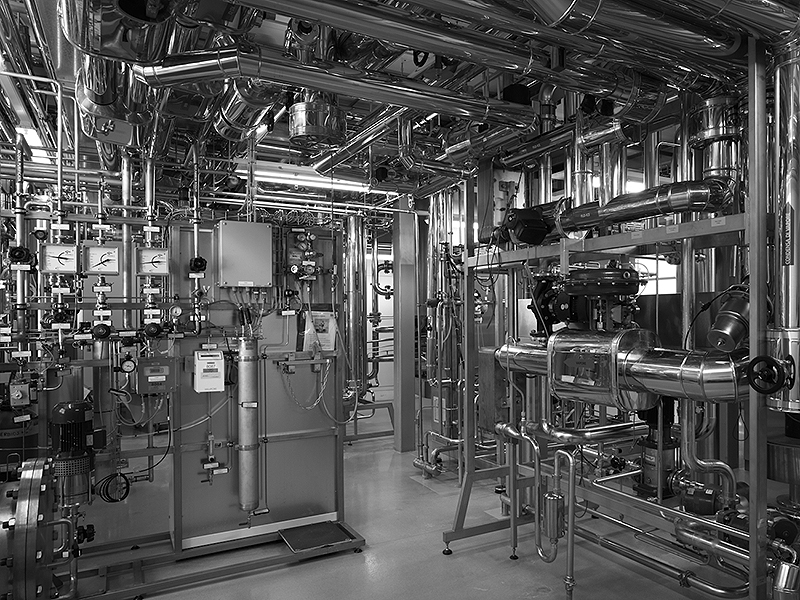
La fortuna del fotografo è poter scoprire questi luoghi; la mia è stata quella di poterlo fare con Helsinn. Ho avuto la possibilità di lavorare in questi spazi e di capire che la loro straordinarietà non si esaurisce negli uffici o nei macchinari di produzione, ma che si tratta di aziende simili a organismi viventi: per funzionare hanno bisogno di un apparato respiratorio e circolatorio, sofisticati impianti di ventilazione e di purificazione dell’aria e dell’acqua, percorsi precisi per le materie prime e per le persone, per garantire sicurezza al prodotto e a chi vi lavora.
Da qui nasce la mia volontà di raccontare, attraverso la macchina fotografica, tutta la complessità di questi luoghi: un susseguirsi di immagini che parlano di uffici, di spazi in cui si lavorano principi attivi e farmaci, di “semplici” camere dedicate alla meticolosa vestizione degli operatori, di laboratori e di intricati sistemi di condotte e impianti di controllo ambientale, e infine del paesaggio e delle città che ospitano le sedi di Helsinn. Cercando, in qualche modo, di essere come quel fotografo dell’Ottocento che stupiva l’osservatore con le sue immagini.
Marco Introini per Helsinn
11.11. 2012
Image of the pharmaceutical world
The nineteenth century was a crucial period for photography, not only because that is when it was invented (the first photograph dates to 1826 and is by the French author Nicéphore Niépce), but also because through it the world began to be discovered.
Explorers and ordinary travellers no longer returned with sketches and watercolours that only a few acquaintances could see, but, thanks to the camera, they produced images which, through their mechanical veracity, conveyed the certainty of reality. There was no longer any doubt that what appeared on that printed sheet might be an invention or a distortion of a place or a building in distant, unreachable countries: it was the truth, it was what light had impressed on a glass plate and then transferred onto paper. Beyond this truthfulness, photographs could be disseminated everywhere as postcards, albums and books; they could be reproduced “infinitely”, and in this way the world became accessible to everyone.
I have always been fascinated by the photographs of nineteenth‑century travellers for their beauty. If I think of the amazement with which viewers must have looked at an image by Felice Beato (a Venetian photographer who, in the second half of the nineteenth century, left for the Far East, collecting hundreds of images of the countries he visited), perhaps of the Taj Mahal or of some other distant place, I remain struck by their explosive power in the imagination of the time. Today we are used to seeing these once exotic places through thousands of photographs, documentaries, films and travel brochures, and we are rarely truly astonished.
It almost seems that the contemporary photographer can only refine and perfect their gaze when framing the world. Yet there are places very close to us, unknown, difficult to access and almost never represented, that are still capable of arousing curiosity, wonder and fascination: high‑technology companies where scientific and technological research reaches the highest levels, such as hardware industries, aerospace facilities and pharmaceutical companies. These are realities that, in order to function, require complex systems and extremely sophisticated environmental controls, which make them inaccessible to most people.
A photographer’s privilege is to be able to discover these places; my good fortune was to be able to do so with Helsinn. I had the opportunity to work in these spaces and to understand that their extraordinariness does not end with the offices or production machinery, but that they are companies similar to living organisms: in order to function they need a respiratory and circulatory apparatus, sophisticated systems for the ventilation and purification of air and water, specific routes for raw materials and for people, so as to guarantee the safety of both the product and those who work there.
From here arises my intention to narrate, through the camera, the full complexity of these places: a succession of images that speak of offices, of spaces where active ingredients and medicines are processed, of “simple” rooms dedicated to the meticulous dressing of operators, of laboratories and intricate networks of ducts and environmental control systems, and finally of the landscape and the cities that host Helsinn’s headquarters. Trying, in some way, to stand in the shoes of those nineteenth‑century photographers who amazed viewers with their images.
Marco Introini for Helsinn
11.11. 2012
L’Ottocento è stato un secolo fondamentale per la fotografia, non solo perché in quel periodo è stata inventata (la prima fotografia è del 1826, ad opera del francese Nicéphore Niépce), ma anche perché attraverso di essa si è cominciato a scoprire il mondo.
Esploratori e semplici viaggiatori non raccoglievano più schizzi e acquerelli che solo pochi conoscenti potevano vedere, ma grazie alla macchina fotografica producevano immagini che, con la loro meccanica veridicità, trasmettevano la certezza della realtà. Non c’era più il dubbio che ciò che appariva su quel foglio stampato fosse un’invenzione o una deformazione di un luogo o di un edificio in paesi lontani e irraggiungibili: era la verità, era ciò che la luce aveva impresso su una lastra di vetro e poi trasferito su carta. Oltre a questa veridicità, le fotografie avevano la possibilità di essere divulgate ovunque come cartoline, album, libri; potevano essere riprodotte “all’infinito” e così il mondo diventava conoscibile da tutti.
Sono sempre rimasto affascinato dalle fotografie dei viaggiatori ottocenteschi per la loro bellezza. Se penso con quale stupore l’osservatore guardava un’immagine di Felice Beato (fotografo veneziano che nella seconda metà dell’Ottocento parte per l’Estremo Oriente raccogliendo centinaia di immagini dei paesi visitati), magari del Taj Mahal o di qualche altro luogo lontano, rimango colpito dalla loro forza dirompente nell’immaginario dell’epoca. Oggi siamo abituati a vedere questi luoghi un tempo esotici attraverso migliaia di fotografie, documentari, film, dépliant di viaggio, senza grande stupore.
Sembra quasi che il fotografo contemporaneo possa solo perfezionare e raffinare lo sguardo quando inquadra il mondo. Eppure esistono luoghi molto vicini a noi, sconosciuti, difficili da raggiungere e quasi mai rappresentati, che ancora riescono a incuriosire, stupire, affascinare: sono le aziende ad alta tecnologia, dove la ricerca scientifica e tecnologica raggiunge livelli altissimi, come le industrie di hardware, gli impianti aerospaziali, le aziende farmaceutiche. Realtà che, per poter funzionare, hanno bisogno di impianti complessi e di controlli ambientali sofisticatissimi, che le rendono inaccessibili ai più.
La fortuna del fotografo è poter scoprire questi luoghi; la mia è stata quella di poterlo fare con Helsinn. Ho avuto la possibilità di lavorare in questi spazi e di capire che la loro straordinarietà non si esaurisce negli uffici o nei macchinari di produzione, ma che si tratta di aziende simili a organismi viventi: per funzionare hanno bisogno di un apparato respiratorio e circolatorio, sofisticati impianti di ventilazione e di purificazione dell’aria e dell’acqua, percorsi precisi per le materie prime e per le persone, per garantire sicurezza al prodotto e a chi vi lavora.
Da qui nasce la mia volontà di raccontare, attraverso la macchina fotografica, tutta la complessità di questi luoghi: un susseguirsi di immagini che parlano di uffici, di spazi in cui si lavorano principi attivi e farmaci, di “semplici” camere dedicate alla meticolosa vestizione degli operatori, di laboratori e di intricati sistemi di condotte e impianti di controllo ambientale, e infine del paesaggio e delle città che ospitano le sedi di Helsinn. Cercando, in qualche modo, di essere come quel fotografo dell’Ottocento che stupiva l’osservatore con le sue immagini.
Marco Introini per Helsinn
11.11. 2012
Image of the pharmaceutical world
The nineteenth century was a crucial period for photography, not only because that is when it was invented (the first photograph dates to 1826 and is by the French author Nicéphore Niépce), but also because through it the world began to be discovered.
Explorers and ordinary travellers no longer returned with sketches and watercolours that only a few acquaintances could see, but, thanks to the camera, they produced images which, through their mechanical veracity, conveyed the certainty of reality. There was no longer any doubt that what appeared on that printed sheet might be an invention or a distortion of a place or a building in distant, unreachable countries: it was the truth, it was what light had impressed on a glass plate and then transferred onto paper. Beyond this truthfulness, photographs could be disseminated everywhere as postcards, albums and books; they could be reproduced “infinitely”, and in this way the world became accessible to everyone.
I have always been fascinated by the photographs of nineteenth‑century travellers for their beauty. If I think of the amazement with which viewers must have looked at an image by Felice Beato (a Venetian photographer who, in the second half of the nineteenth century, left for the Far East, collecting hundreds of images of the countries he visited), perhaps of the Taj Mahal or of some other distant place, I remain struck by their explosive power in the imagination of the time. Today we are used to seeing these once exotic places through thousands of photographs, documentaries, films and travel brochures, and we are rarely truly astonished.
It almost seems that the contemporary photographer can only refine and perfect their gaze when framing the world. Yet there are places very close to us, unknown, difficult to access and almost never represented, that are still capable of arousing curiosity, wonder and fascination: high‑technology companies where scientific and technological research reaches the highest levels, such as hardware industries, aerospace facilities and pharmaceutical companies. These are realities that, in order to function, require complex systems and extremely sophisticated environmental controls, which make them inaccessible to most people.
A photographer’s privilege is to be able to discover these places; my good fortune was to be able to do so with Helsinn. I had the opportunity to work in these spaces and to understand that their extraordinariness does not end with the offices or production machinery, but that they are companies similar to living organisms: in order to function they need a respiratory and circulatory apparatus, sophisticated systems for the ventilation and purification of air and water, specific routes for raw materials and for people, so as to guarantee the safety of both the product and those who work there.
From here arises my intention to narrate, through the camera, the full complexity of these places: a succession of images that speak of offices, of spaces where active ingredients and medicines are processed, of “simple” rooms dedicated to the meticulous dressing of operators, of laboratories and intricate networks of ducts and environmental control systems, and finally of the landscape and the cities that host Helsinn’s headquarters. Trying, in some way, to stand in the shoes of those nineteenth‑century photographers who amazed viewers with their images.
Marco Introini for Helsinn
11.11. 2012
to photo work