TEXTS
Bianco e nero a colori
Una fotografia che è quindi una forma di atteggiamento critico e risolutivo nei confronti dei dogmi e delle profezie che si auto rivela dalla conoscenza e dagli obblighi del percorso della rappresentazione figurativa. Enzo Carli1
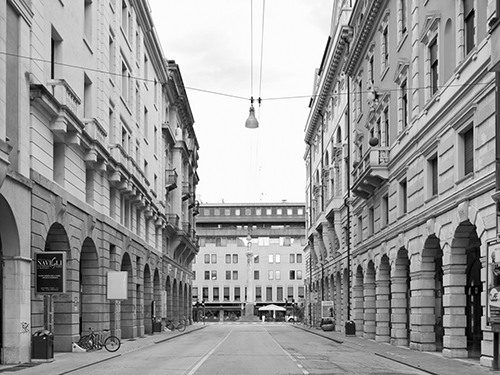
Non manca nessun grigio nella gamma dei colori di Marco Introini, nessuna tonalità è assente nella ricercata capacità propria della tinta neutra di raccontare lo spazio attraverso la sua differente gradazione, la sua intensità, la sua evidenza resa per contrasto. Non esiste il bianco, non esiste il nero in assolo, nel suo lavoro, ma uno spettro infinito che partendo dagli estremi citati elegge la tinta mediana quale unico colore ammissibile. Un colore ricco e denso, prezioso, opaco, eloquente nel descrivere lo spazio, memore della più alta lezione della pittura che ben conosce il valore del grigio quando scaturisce, nella sua più elegante varietà, non dalla somma teorica delle due tinte opposte – bianco e nero appunto – ma da una sapiente e dosata quantità di blu di Prussia e di ocra che attraverso variazioni microscopiche consegnano irripetibili nuance. Nessun grigio è uguale ad un altro.
La luce si perde volentieri in questa varietà di toni, precisa e tagliente, eterogenea nel delineare i contorni, così efficace da far emergere irrimediabilmente la forma. Sembra di immaginare gli anni dello sviluppo fotografico eseguito a mano, l’epoca appena passata ma già remota dei grandi provini a contatto, quel tempo determinato che nell’attesa, piano piano, vedeva emergere la spazialità ricercata a partire dal buio che prima di tutto avvolgeva la stanza dello sviluppo. Forse è proprio questa la prima e più importante qualità nella fotografia di Introini, che padroneggia da anni la questione tecnica interpretandola come un alchimista, questo saper far emergere la forma dalla realtà che indaga, questa capacità critica che sostanzia un lavoro che da subito ti colpisce per la sua chiarezza accattivante ma appena dopo ti abbatte per la complessità della riflessione sulla natura antropizzante dell’uomo. Un lavoro complesso, un progetto fotografico, che svela da subito una precisa formazione culturale e, solo alla fine, ammicca ad un’ecclettica personalità che come ogni artista conserva nascosta se non ricercata con occhi attenti all’interno di ogni scatto. Marco è un architetto prestato all’immagine; tutti lo pensano ma nessuno lo riesce a definire chiaramente perché il confine tra le due sensibilità è cosi labile che spesso le discipline si stemperano l’una nell’altra ovvero costruiscono una nuova categoria che immagina architettura da dietro l’obiettivo. Un’attenzione maniacale al taglio e al tempo che senza ancora affrontare il tema caro della composizione stabilisce i confini fisici e culturali di un lavoro poetico. Una vicinanza così stretta che confonde la ricerca di uno e dell’atro interesse uniti alla base da un’idea di conoscenza che precede, accompagna e segue il lavoro. La vicinanza supposta, se è certamente vera nel caso dell’architettura che nutre i suoi progetti con la più precisa conoscenza dei temi da trattare, si rispecchia con altrettanta profondità nella ricerca per immagini che ancor di più in questa epoca riescono a interpretare, nel disimpegno collettivo rispetto alla fatica del testo, i valori trasmessi da un progetto contemporaneo. Percorsi lineari e racconti circolari sono solo alcuni degli stratagemmi usati nella fotografia di Marco Introini per raccontare lo spazio costruito, strutture verbali che sia da progettista che da critico aiutano spesso a ordinare verso un fine preciso la raccolta sistematica dei dati. Madrid da est a ovest, lungo il fiume a Los Angeles, il bacino del Po, cito i titoli delle serie volutamente a memoria per sottolineare unicamente il principio e il campo d’azione, e poi ancora Padova a più riprese, Milano congelata nelle sue epoche più felici, poi ancora in America – Detroit, Chicago, New York –, Shanghai e tutto il modo orientale, e costante invece la ricerca sul tappeto padano che da Piacenza in poi costruisce un fil rouge che con intervalli regolari inanella poesie come città e racconti come paesaggi certamente più vicini alla nostra sensibilità.
Tutto questo nel tempo ha preso volentieri una dimensione personale nella narrazione, un modo autentico che deve a chi lo ha preceduto e con il quale ha condiviso troppo poche stagioni, la spinta iniziale ma che ormai vive nella più vera autonomia che senza ripensamenti specifica ogni volta i termini fissati nel tempo. Ogni nuova sezione viene annunciata dagli schizzi, ogni campagna immaginata e tradotta già prima di ogni scatto, passeggiando nei luoghi, con la macchina – questa si – ancora a spalla e la matita ben salda nella mano, pronta immaginare composizioni dialettiche.2
Il ritmo serrato, le scritture asfittiche segnano l’emozione più grande nel lavoro di Marco, la capacità di raccontare, partendo dal reale la teatralità dello spazio costruito. Relazioni che sommano epoche e culture negli spazi saturi della fotografia senza respiro e senza via di fuga, un lavoro ritmato che alterna la concitazione del confronto stretto tra le architetture al largo dei paesaggi come nella composizione musicale il ritmo concitato alle pause. Senza vita ritratta, solo per negazione si dimostra il lavoro dell’uomo che compare in un’assenza che mai tradisce questa scelta. Un carattere preciso affinato e raffinato, un lavoro di riscrittura che si percepisce lentamente come quando si entra in uno spazio buio e gli oggetti compaiono senza fretta una volta che l’occhio è riuscito finalmente a catturare la luce. Richiede attenzione la fotografia di Introini, per capere e condividere le scelte precise che ogni scatto contiene fino al bordo dell’immagine che lui ri-scruta ogni volta con l’oculare del banco ottico, nascosto sotto il telo nero. Angoli tagliati e spigoli avanzati non spaventano chi ritrae la realtà nel punto preciso della presa, senza la minima deformazione ammissibile forte di una tecnica che rasenta il grado zero dell’artefatto e della mistificazione. Non solo i maestri conosciuti hanno un ruolo strategico in questa scelta di vita – da Gabriele Basilico a Gianni Berengo Gardin, fino a Guido Guidi – ma l’invadenza in questo DNA fotografico di una storia della Fotografia di poco maggiore di cent’anni che Marco Introini conosce molto bene.
Alla prima occasione più di quindici anni fa ci siamo lanciati in una delle prime spericolate ricerche sul campo, anch’io presente; proprio in Emilia, proprio a Piacenza abbiamo censito a partire dal pretesto della rappresentazione delle architetture del novecento, che era il tema principale, ogni spazio urbano in un archivio di confronti che già indicavano il taglio che la fotografia di Marco avrebbe preso. Epoche e architetture fissate da entomologo che oggi rappresentano bene una società comunque passata e segnano in modo definitivo il mutamento del secolo. La follia poi di trasformare questo materiale in un’occasione pubblica con la proiezione simultanea delle immagini all’interno del cantiere dell’infrastruttura interrata tangenziale alla città – allora in costruzione – ha fissato oltre la passione comune per la trasgressione, un’amicizia costante e certa.
[…] La proiezione delle immagini è simultanea e continua per tutto il tempo della permanenza del pubblico, seguendo un ritmo di foto e pause che ricalca la proiezione matematica dei rumori registrati in cantiere durante i lavori. Schermo e proiettori sono posizionati al centro del tunnel. Allontanati, di un centinaio di metri, dall’illuminazione naturale – all’imboccatura e all’uscita – approfittando del buio appartenente all’anima della galleria. Il fondo stradale ancora in costruzione, è lo spazio per gli spettatori da cui guardare Piacenza camminando sotto Piacenza. L’unicità ricercata in questa esperienza sta nella possibilità – non ripetibile – di vivere il tunnel ad un ritmo improprio. Nel luogo destinato alla velocità del traffico veicolare, al solo transito delle automobili in corsa indifferenti al sito, si scende lentamente a piedi. Ci si avvicina a questo luogo del movimento veloce con i tempi lenti dei luoghi dell’arte; consapevolmente e per stare. Si guadagna passo-passo il giusto grado d’oscurità e di silenzio per assistere, alla quota delle infrastrutture solitamente invisibili, prive di bordi significanti e di rapporto diretto con la complessità urbana, al racconto per immagini della città costruita. […]3
Massimo Ferrari, in Marco Introini, Padova ed altri paesaggio, Padova 2018
NOTE
1 da un intervento di Enzo Carli per raccontare le vicende del Manifesto del Passaggio di frontiera, stilato da alcuni fotografi senigalliesi, tra cui Mario Giacomelli, Ferruccio Ferroni e Sofio Valenti
2 Aa.Vv., Dialectical Landscape / Nuovo Paesaggio Americano, Electa, Milano 1987
3 Massimo Ferrari, Olga Chiesa (a cura di), Marco Introini. Fotografie 2000-2003, Vicolo del Pavone, Piacenza 2003
Black and white in color
A photograph is therefore a form of critical and resolute attitude towards dogmas and prophecies, which reveals itself through knowledge and through the constraints of the path of figurative representation.¹
No shade of grey is missing from Marco Introini’s range of colors; no tone is absent from the refined ability of that neutral hue to tell space through its different gradations, its intensity, its evidence rendered by contrast. In his work there is no such thing as white, no such thing as black on their own, but an infinite spectrum which, starting from these two extremes, chooses the middle hue as the only admissible color. A rich and dense color, precious, matt, eloquent in its description of space, mindful of the highest lessons of painting, which knows well the value of grey when it arises, in its most elegant variety, not from the theoretical sum of two opposite tones – black and white, precisely – but from a skilful and measured quantity of Prussian blue and ochre which, through microscopic variations, yields unrepeatable nuances. No grey is identical to another.
Light gladly loses itself in this variety of tones, sharp and precise, heterogeneous in outlining contours, so effective that it inevitably brings form to the fore. One is tempted to imagine the years of photographic development carried out by hand, the era just past yet already remote of large contact sheets, that defined time which, in waiting, little by little saw the sought-after spatiality emerge from the darkness that first of all enveloped the developing room. Perhaps this is the first and most important quality in Introini’s photography, who has mastered technical matters for years and interprets them like an alchemist: this ability to let form emerge from the reality he investigates, this critical capacity that underpins a body of work which at first strikes you for its engaging clarity and then soon overwhelms you with the complexity of its reflection on the anthropizing nature of man. A complex work, a photographic project, which immediately reveals a precise cultural background and, only in the end, hints at an eclectic personality that, like every artist, he keeps hidden if not sought out with attentive eyes within every shot. Marco is an architect lent to the image; everyone thinks so, but no one manages to define it clearly because the boundary between the two sensibilities is so thin that the disciplines often dissolve into one another, or rather, construct a new category that imagines architecture from behind the lens. A meticulous attention to framing and to time, which, even before addressing the cherished theme of composition, establishes the physical and cultural boundaries of a poetic work. A closeness so tight that it confuses the research into one and the other interest, united at their root by an idea of knowledge that precedes, accompanies and follows the work. The supposed closeness, which is certainly true in the case of architecture that nourishes its projects with the most precise knowledge of the subjects to be addressed, is mirrored with equal depth in his research through images which, especially in this era, manages to interpret – in a collective disengagement from the effort of the written text – the values conveyed by a contemporary project. Linear paths and circular narratives are just some of the devices used in Marco Introini’s photography to recount built space, verbal structures which, both as designer and as critic, often help to organize towards a precise goal the systematic collection of data. Madrid from east to west, along the river in Los Angeles, the Po basin – I deliberately cite these series titles from memory only to underline their principle and field of action – and then again Padua on several occasions, Milan frozen in its happiest periods, then once more America – Detroit, Chicago, New York –, Shanghai and the entire Eastern world, and constant instead the research on the Po plain which from Piacenza onwards builds a fil rouge that, at regular intervals, strings together poems as cities and tales as landscapes, certainly closer to our sensibility.
Over time all this has willingly taken on a personal dimension in the narration, an authentic way that owes to those who preceded him – and with whom he shared far too few seasons – the initial impulse, but which now lives in the truest autonomy, each time precisely specifying the terms laid down over the years without second thoughts. Each new section is announced by sketches; each campaign is imagined and translated even before any shot, walking through places, with the camera – this one – still slung over his shoulder and the pencil held firmly in his hand, ready to imagine dialectical compositions.²
The tight rhythm, the terse writings mark the greatest emotion in Marco’s work: his ability to narrate, starting from reality, the theatricality of built space. Relationships that sum up eras and cultures in the saturated spaces of photographs without breath and without escape routes, a work with its own rhythm that alternates the urgency of close confrontation between architectures with the openness of landscapes, just as in musical composition the agitated tempo alternates with pauses. Without life portrayed, only by negation is the work of man demonstrated, appearing through an absence that never betrays this choice. A precise character, honed and refined, a work of rewriting that is gradually perceived like when one enters a dark space and objects appear unhurriedly once the eye has finally managed to capture the light. Introini’s photography demands attention in order to understand and share the precise choices contained in each shot, right to the edge of the image, which he re-scrutinizes each time through the viewfinder of the large-format camera, hidden beneath the black cloth. Cropped corners and protruding edges do not frighten someone who portrays reality at the precise point of capture, with no acceptable distortion, relying on a technique that verges on the degree zero of artifice and mystification. Not only do the recognised masters play a strategic role in this life choice – from Gabriele Basilico to Gianni Berengo Gardin, up to Guido Guidi – but also the pervasive presence in this photographic DNA of a history of Photography of just over a hundred years, which Marco Introini knows very well.
At the first opportunity, more than fifteen years ago, we threw ourselves into one of the first daring field researches, I too being present; in Emilia, precisely in Piacenza, we carried out a survey which, starting from the pretext of representing twentieth-century architecture – which was the main theme – catalogued every urban space in an archive of comparisons that already indicated the direction that Marco’s photography would take. Eras and architectures captured like an entomologist, which today well represent a society that has in any case passed and definitively mark the change of the century. The madness, then, of transforming this material into a public opportunity, with the simultaneous projection of images inside the construction site of the underground ring road on the edge of the city – then under construction – fixed, beyond the shared passion for transgression, a constant and certain friendship.
[…] The projection of the images is simultaneous and continuous for the entire time the public remains, following a rhythm of photographs and pauses that retraces the mathematical projection of the noises recorded on site during the works. The screen and projectors are placed at the centre of the tunnel. They are set back, about a hundred metres, from the natural light – at the entrance and at the exit – taking advantage of the darkness belonging to the very soul of the gallery. The road surface, still under construction, is the space for spectators, from which to look at Piacenza while walking beneath Piacenza. The uniqueness sought in this experience lies in the – unrepeatable – possibility of living the tunnel at an improper rhythm. In the place destined for the speed of vehicle traffic, for the mere transit of cars racing by indifferent to the site, one descends slowly on foot. One approaches this place of fast movement with the slow times of places of art, deliberately and in order to linger. Step by step, one gains the proper degree of darkness and silence to attend, at the level of the infrastructures usually invisible, devoid of meaningful edges and of any direct relationship with urban complexity, the visual account of the built city. […]³
Massimo Ferrari, in Marco Introini, Padova e altri paesaggi, Padua 2018.
NOTE
1 From a talk by Enzo Carli recounting the events of the “Manifesto del passaggio di frontiera”, drawn up by some photographers from Senigallia, among them Mario Giacomelli, Ferruccio Ferroni and Sofio Valenti.
2 Aa.Vv., Dialectical Landscape / Nuovo Paesaggio Americano, Electa, Milan 1987.
3 Massimo Ferrari, Olga Chiesa (eds.), Marco Introini. Fotografie 2000–2003, Vicolo del Pavone, Piacenza 2003.
Una fotografia che è quindi una forma di atteggiamento critico e risolutivo nei confronti dei dogmi e delle profezie che si auto rivela dalla conoscenza e dagli obblighi del percorso della rappresentazione figurativa. Enzo Carli1
Non manca nessun grigio nella gamma dei colori di Marco Introini, nessuna tonalità è assente nella ricercata capacità propria della tinta neutra di raccontare lo spazio attraverso la sua differente gradazione, la sua intensità, la sua evidenza resa per contrasto. Non esiste il bianco, non esiste il nero in assolo, nel suo lavoro, ma uno spettro infinito che partendo dagli estremi citati elegge la tinta mediana quale unico colore ammissibile. Un colore ricco e denso, prezioso, opaco, eloquente nel descrivere lo spazio, memore della più alta lezione della pittura che ben conosce il valore del grigio quando scaturisce, nella sua più elegante varietà, non dalla somma teorica delle due tinte opposte – bianco e nero appunto – ma da una sapiente e dosata quantità di blu di Prussia e di ocra che attraverso variazioni microscopiche consegnano irripetibili nuance. Nessun grigio è uguale ad un altro.
La luce si perde volentieri in questa varietà di toni, precisa e tagliente, eterogenea nel delineare i contorni, così efficace da far emergere irrimediabilmente la forma. Sembra di immaginare gli anni dello sviluppo fotografico eseguito a mano, l’epoca appena passata ma già remota dei grandi provini a contatto, quel tempo determinato che nell’attesa, piano piano, vedeva emergere la spazialità ricercata a partire dal buio che prima di tutto avvolgeva la stanza dello sviluppo. Forse è proprio questa la prima e più importante qualità nella fotografia di Introini, che padroneggia da anni la questione tecnica interpretandola come un alchimista, questo saper far emergere la forma dalla realtà che indaga, questa capacità critica che sostanzia un lavoro che da subito ti colpisce per la sua chiarezza accattivante ma appena dopo ti abbatte per la complessità della riflessione sulla natura antropizzante dell’uomo. Un lavoro complesso, un progetto fotografico, che svela da subito una precisa formazione culturale e, solo alla fine, ammicca ad un’ecclettica personalità che come ogni artista conserva nascosta se non ricercata con occhi attenti all’interno di ogni scatto. Marco è un architetto prestato all’immagine; tutti lo pensano ma nessuno lo riesce a definire chiaramente perché il confine tra le due sensibilità è cosi labile che spesso le discipline si stemperano l’una nell’altra ovvero costruiscono una nuova categoria che immagina architettura da dietro l’obiettivo. Un’attenzione maniacale al taglio e al tempo che senza ancora affrontare il tema caro della composizione stabilisce i confini fisici e culturali di un lavoro poetico. Una vicinanza così stretta che confonde la ricerca di uno e dell’atro interesse uniti alla base da un’idea di conoscenza che precede, accompagna e segue il lavoro. La vicinanza supposta, se è certamente vera nel caso dell’architettura che nutre i suoi progetti con la più precisa conoscenza dei temi da trattare, si rispecchia con altrettanta profondità nella ricerca per immagini che ancor di più in questa epoca riescono a interpretare, nel disimpegno collettivo rispetto alla fatica del testo, i valori trasmessi da un progetto contemporaneo. Percorsi lineari e racconti circolari sono solo alcuni degli stratagemmi usati nella fotografia di Marco Introini per raccontare lo spazio costruito, strutture verbali che sia da progettista che da critico aiutano spesso a ordinare verso un fine preciso la raccolta sistematica dei dati. Madrid da est a ovest, lungo il fiume a Los Angeles, il bacino del Po, cito i titoli delle serie volutamente a memoria per sottolineare unicamente il principio e il campo d’azione, e poi ancora Padova a più riprese, Milano congelata nelle sue epoche più felici, poi ancora in America – Detroit, Chicago, New York –, Shanghai e tutto il modo orientale, e costante invece la ricerca sul tappeto padano che da Piacenza in poi costruisce un fil rouge che con intervalli regolari inanella poesie come città e racconti come paesaggi certamente più vicini alla nostra sensibilità.
Tutto questo nel tempo ha preso volentieri una dimensione personale nella narrazione, un modo autentico che deve a chi lo ha preceduto e con il quale ha condiviso troppo poche stagioni, la spinta iniziale ma che ormai vive nella più vera autonomia che senza ripensamenti specifica ogni volta i termini fissati nel tempo. Ogni nuova sezione viene annunciata dagli schizzi, ogni campagna immaginata e tradotta già prima di ogni scatto, passeggiando nei luoghi, con la macchina – questa si – ancora a spalla e la matita ben salda nella mano, pronta immaginare composizioni dialettiche.2
Il ritmo serrato, le scritture asfittiche segnano l’emozione più grande nel lavoro di Marco, la capacità di raccontare, partendo dal reale la teatralità dello spazio costruito. Relazioni che sommano epoche e culture negli spazi saturi della fotografia senza respiro e senza via di fuga, un lavoro ritmato che alterna la concitazione del confronto stretto tra le architetture al largo dei paesaggi come nella composizione musicale il ritmo concitato alle pause. Senza vita ritratta, solo per negazione si dimostra il lavoro dell’uomo che compare in un’assenza che mai tradisce questa scelta. Un carattere preciso affinato e raffinato, un lavoro di riscrittura che si percepisce lentamente come quando si entra in uno spazio buio e gli oggetti compaiono senza fretta una volta che l’occhio è riuscito finalmente a catturare la luce. Richiede attenzione la fotografia di Introini, per capere e condividere le scelte precise che ogni scatto contiene fino al bordo dell’immagine che lui ri-scruta ogni volta con l’oculare del banco ottico, nascosto sotto il telo nero. Angoli tagliati e spigoli avanzati non spaventano chi ritrae la realtà nel punto preciso della presa, senza la minima deformazione ammissibile forte di una tecnica che rasenta il grado zero dell’artefatto e della mistificazione. Non solo i maestri conosciuti hanno un ruolo strategico in questa scelta di vita – da Gabriele Basilico a Gianni Berengo Gardin, fino a Guido Guidi – ma l’invadenza in questo DNA fotografico di una storia della Fotografia di poco maggiore di cent’anni che Marco Introini conosce molto bene.
Alla prima occasione più di quindici anni fa ci siamo lanciati in una delle prime spericolate ricerche sul campo, anch’io presente; proprio in Emilia, proprio a Piacenza abbiamo censito a partire dal pretesto della rappresentazione delle architetture del novecento, che era il tema principale, ogni spazio urbano in un archivio di confronti che già indicavano il taglio che la fotografia di Marco avrebbe preso. Epoche e architetture fissate da entomologo che oggi rappresentano bene una società comunque passata e segnano in modo definitivo il mutamento del secolo. La follia poi di trasformare questo materiale in un’occasione pubblica con la proiezione simultanea delle immagini all’interno del cantiere dell’infrastruttura interrata tangenziale alla città – allora in costruzione – ha fissato oltre la passione comune per la trasgressione, un’amicizia costante e certa.
[…] La proiezione delle immagini è simultanea e continua per tutto il tempo della permanenza del pubblico, seguendo un ritmo di foto e pause che ricalca la proiezione matematica dei rumori registrati in cantiere durante i lavori. Schermo e proiettori sono posizionati al centro del tunnel. Allontanati, di un centinaio di metri, dall’illuminazione naturale – all’imboccatura e all’uscita – approfittando del buio appartenente all’anima della galleria. Il fondo stradale ancora in costruzione, è lo spazio per gli spettatori da cui guardare Piacenza camminando sotto Piacenza. L’unicità ricercata in questa esperienza sta nella possibilità – non ripetibile – di vivere il tunnel ad un ritmo improprio. Nel luogo destinato alla velocità del traffico veicolare, al solo transito delle automobili in corsa indifferenti al sito, si scende lentamente a piedi. Ci si avvicina a questo luogo del movimento veloce con i tempi lenti dei luoghi dell’arte; consapevolmente e per stare. Si guadagna passo-passo il giusto grado d’oscurità e di silenzio per assistere, alla quota delle infrastrutture solitamente invisibili, prive di bordi significanti e di rapporto diretto con la complessità urbana, al racconto per immagini della città costruita. […]3
Massimo Ferrari, in Marco Introini, Padova ed altri paesaggio, Padova 2018
NOTE
1 da un intervento di Enzo Carli per raccontare le vicende del Manifesto del Passaggio di frontiera, stilato da alcuni fotografi senigalliesi, tra cui Mario Giacomelli, Ferruccio Ferroni e Sofio Valenti
2 Aa.Vv., Dialectical Landscape / Nuovo Paesaggio Americano, Electa, Milano 1987
3 Massimo Ferrari, Olga Chiesa (a cura di), Marco Introini. Fotografie 2000-2003, Vicolo del Pavone, Piacenza 2003
Black and white in color
A photograph is therefore a form of critical and resolute attitude towards dogmas and prophecies, which reveals itself through knowledge and through the constraints of the path of figurative representation.¹
No shade of grey is missing from Marco Introini’s range of colors; no tone is absent from the refined ability of that neutral hue to tell space through its different gradations, its intensity, its evidence rendered by contrast. In his work there is no such thing as white, no such thing as black on their own, but an infinite spectrum which, starting from these two extremes, chooses the middle hue as the only admissible color. A rich and dense color, precious, matt, eloquent in its description of space, mindful of the highest lessons of painting, which knows well the value of grey when it arises, in its most elegant variety, not from the theoretical sum of two opposite tones – black and white, precisely – but from a skilful and measured quantity of Prussian blue and ochre which, through microscopic variations, yields unrepeatable nuances. No grey is identical to another.
Light gladly loses itself in this variety of tones, sharp and precise, heterogeneous in outlining contours, so effective that it inevitably brings form to the fore. One is tempted to imagine the years of photographic development carried out by hand, the era just past yet already remote of large contact sheets, that defined time which, in waiting, little by little saw the sought-after spatiality emerge from the darkness that first of all enveloped the developing room. Perhaps this is the first and most important quality in Introini’s photography, who has mastered technical matters for years and interprets them like an alchemist: this ability to let form emerge from the reality he investigates, this critical capacity that underpins a body of work which at first strikes you for its engaging clarity and then soon overwhelms you with the complexity of its reflection on the anthropizing nature of man. A complex work, a photographic project, which immediately reveals a precise cultural background and, only in the end, hints at an eclectic personality that, like every artist, he keeps hidden if not sought out with attentive eyes within every shot. Marco is an architect lent to the image; everyone thinks so, but no one manages to define it clearly because the boundary between the two sensibilities is so thin that the disciplines often dissolve into one another, or rather, construct a new category that imagines architecture from behind the lens. A meticulous attention to framing and to time, which, even before addressing the cherished theme of composition, establishes the physical and cultural boundaries of a poetic work. A closeness so tight that it confuses the research into one and the other interest, united at their root by an idea of knowledge that precedes, accompanies and follows the work. The supposed closeness, which is certainly true in the case of architecture that nourishes its projects with the most precise knowledge of the subjects to be addressed, is mirrored with equal depth in his research through images which, especially in this era, manages to interpret – in a collective disengagement from the effort of the written text – the values conveyed by a contemporary project. Linear paths and circular narratives are just some of the devices used in Marco Introini’s photography to recount built space, verbal structures which, both as designer and as critic, often help to organize towards a precise goal the systematic collection of data. Madrid from east to west, along the river in Los Angeles, the Po basin – I deliberately cite these series titles from memory only to underline their principle and field of action – and then again Padua on several occasions, Milan frozen in its happiest periods, then once more America – Detroit, Chicago, New York –, Shanghai and the entire Eastern world, and constant instead the research on the Po plain which from Piacenza onwards builds a fil rouge that, at regular intervals, strings together poems as cities and tales as landscapes, certainly closer to our sensibility.
Over time all this has willingly taken on a personal dimension in the narration, an authentic way that owes to those who preceded him – and with whom he shared far too few seasons – the initial impulse, but which now lives in the truest autonomy, each time precisely specifying the terms laid down over the years without second thoughts. Each new section is announced by sketches; each campaign is imagined and translated even before any shot, walking through places, with the camera – this one – still slung over his shoulder and the pencil held firmly in his hand, ready to imagine dialectical compositions.²
The tight rhythm, the terse writings mark the greatest emotion in Marco’s work: his ability to narrate, starting from reality, the theatricality of built space. Relationships that sum up eras and cultures in the saturated spaces of photographs without breath and without escape routes, a work with its own rhythm that alternates the urgency of close confrontation between architectures with the openness of landscapes, just as in musical composition the agitated tempo alternates with pauses. Without life portrayed, only by negation is the work of man demonstrated, appearing through an absence that never betrays this choice. A precise character, honed and refined, a work of rewriting that is gradually perceived like when one enters a dark space and objects appear unhurriedly once the eye has finally managed to capture the light. Introini’s photography demands attention in order to understand and share the precise choices contained in each shot, right to the edge of the image, which he re-scrutinizes each time through the viewfinder of the large-format camera, hidden beneath the black cloth. Cropped corners and protruding edges do not frighten someone who portrays reality at the precise point of capture, with no acceptable distortion, relying on a technique that verges on the degree zero of artifice and mystification. Not only do the recognised masters play a strategic role in this life choice – from Gabriele Basilico to Gianni Berengo Gardin, up to Guido Guidi – but also the pervasive presence in this photographic DNA of a history of Photography of just over a hundred years, which Marco Introini knows very well.
At the first opportunity, more than fifteen years ago, we threw ourselves into one of the first daring field researches, I too being present; in Emilia, precisely in Piacenza, we carried out a survey which, starting from the pretext of representing twentieth-century architecture – which was the main theme – catalogued every urban space in an archive of comparisons that already indicated the direction that Marco’s photography would take. Eras and architectures captured like an entomologist, which today well represent a society that has in any case passed and definitively mark the change of the century. The madness, then, of transforming this material into a public opportunity, with the simultaneous projection of images inside the construction site of the underground ring road on the edge of the city – then under construction – fixed, beyond the shared passion for transgression, a constant and certain friendship.
[…] The projection of the images is simultaneous and continuous for the entire time the public remains, following a rhythm of photographs and pauses that retraces the mathematical projection of the noises recorded on site during the works. The screen and projectors are placed at the centre of the tunnel. They are set back, about a hundred metres, from the natural light – at the entrance and at the exit – taking advantage of the darkness belonging to the very soul of the gallery. The road surface, still under construction, is the space for spectators, from which to look at Piacenza while walking beneath Piacenza. The uniqueness sought in this experience lies in the – unrepeatable – possibility of living the tunnel at an improper rhythm. In the place destined for the speed of vehicle traffic, for the mere transit of cars racing by indifferent to the site, one descends slowly on foot. One approaches this place of fast movement with the slow times of places of art, deliberately and in order to linger. Step by step, one gains the proper degree of darkness and silence to attend, at the level of the infrastructures usually invisible, devoid of meaningful edges and of any direct relationship with urban complexity, the visual account of the built city. […]³
Massimo Ferrari, in Marco Introini, Padova e altri paesaggi, Padua 2018.
NOTE
1 From a talk by Enzo Carli recounting the events of the “Manifesto del passaggio di frontiera”, drawn up by some photographers from Senigallia, among them Mario Giacomelli, Ferruccio Ferroni and Sofio Valenti.
2 Aa.Vv., Dialectical Landscape / Nuovo Paesaggio Americano, Electa, Milan 1987.
3 Massimo Ferrari, Olga Chiesa (eds.), Marco Introini. Fotografie 2000–2003, Vicolo del Pavone, Piacenza 2003.
to photo work