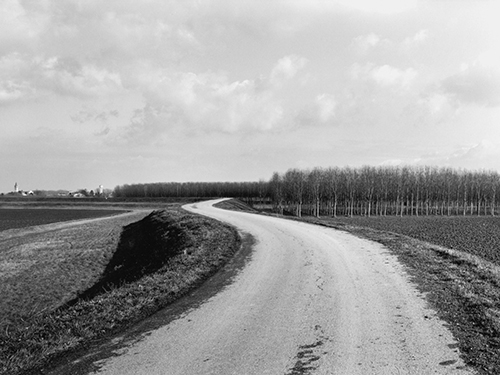
La ricerca intende documentare la particolarità morfologica dell’argine maggiore del Po, elemento significativo della Pianura Padana, tradizionalmente interpretata dall’iconografia e trascritta nella memoria come uno spazio che proietta l’univocità della percezione verso l’infinito.
In realtà l’argine è una costruzione composita, una sezione di paesaggio che unifica dialetticamente i segni naturalistici con il lavoro e il pensiero dell’uomo, fisicizzati e sedimentati nella storia.
L’argine registra la vita materiale e spirituale: non è un semplice vallo di difesa verso il fiume, ma un’architettura che disegna e trasmette la complessità dell’esistenza. Su di esso si attestano strade, architetture idrauliche, chiaviche, canali, opere di estrazione, ma anche presenze religiose. Cattedrali del lavoro si alternano ai monumenti della fede, i cimiteri alla quotidianità degli oratori campestri, forse tracce di antichi culti pagani.
Il rilevato è la spina dorsale del paesaggio, sintesi e osservatorio delle estetiche che esprimono la geometria agraria, la razionalità della produzione, la sacralità del territorio, la totalità degli insediamenti.
Il modo della rappresentazione fa riferimento alla pittura vedutista: esprime la volontà di interpretare lo spazio più che la singolarità degli oggetti e sintetizza un metodo di lavoro che, attraverso la poetica dell’immagine, cerca di analizzare la realtà.
Non si è voluto costruire un catalogo infinito, ma raccogliere quelle immagini che raccolgono gli elementi ordinatori del paesaggio: una visione atemporale che non descrive l’uomo, ma le sue opere.
Marco Introini, 2001
Architecture and architectures of the main Po River embankment
The research aims to document the morphological specificity of the main Po River embankment, a significant element of the Po Valley, traditionally interpreted by iconography and recorded in memory as a space that projects the univocity of perception towards infinity.
In reality, the embankment is a composite construction, a section of landscape that dialectically unifies natural signs with the work and thought of humankind, made physical and sedimented in history.
The embankment records material and spiritual life: it is not a simple defensive rampart against the river, but an architecture that draws and conveys the complexity of existence. Roads, hydraulic architectures, sluices, canals, extraction works, as well as religious presences, are all set upon it. Cathedrals of labour alternate with monuments of faith, cemeteries with the everyday life of rural oratories, perhaps traces of ancient pagan cults.
The embankment is the backbone of the landscape, both synthesis and observatory of the aesthetics that express agrarian geometry, the rationality of production, the sacredness of the territory, and the totality of settlements.
The mode of representation refers to vedutist painting: it expresses the intention to interpret space rather than the singularity of objects, and it encapsulates a working method that seeks to analyse reality through the poetics of the image.
The aim was not to compile an endless catalogue, but to gather those images that collect the ordering elements of the landscape: a timeless vision that does not describe human beings, but their works.
Marco Introini, 2001
to photo work